The planets right next door
28 stars with planets within twenty light-years. None is photographed: all were deduced from their star's wobble, and that changes what can be said about them.
The closest star to the Sun has planets. So does the second. And the third. It isn't an exception: of the 28 stars on this list, every one has at least one confirmed, and between them they add up to 60.
60 planets en 28 systems, within 19.6 light-years. 23 weigh less than twice the Earth. 23 were confirmed from 2020 onwards.
How we know they're there
All 60 were found the same way: radial velocity. Un planeta no orbita alrededor de su estrella: los dos giran alrededor de un punto común, así que la estrella se bambolea. Ese bamboleo acerca y aleja la estrella de nosotros unos metros por segundo, y eso corre sus líneas espectrales lo justo para medirlo.
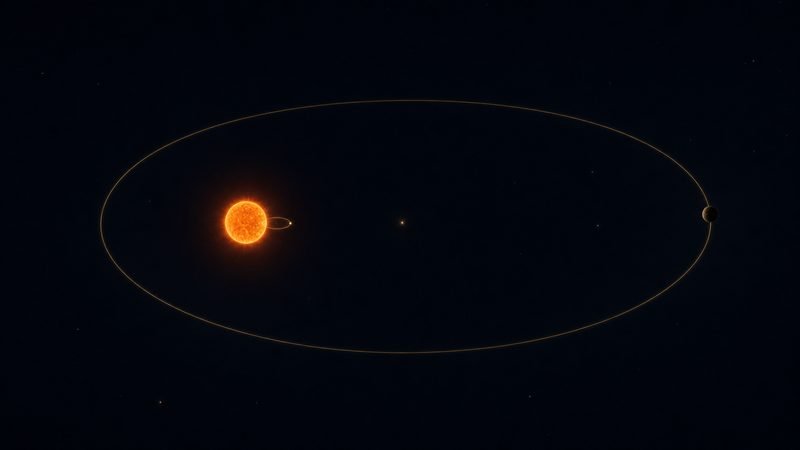
Three things come out of that — and only three: how long the year lasts of the planet, at what distance orbits, and how much mass it has at minimum. Lo demás no sale.
Three caveats that go with every number on this page:
1. None is photographed. Not one of the 60. What you see is the star moving; the planet is deduced.
2. The mass is a minimum. The method measures the wobble along our line of sight. If the orbit is tilted, the planet weighs more than the number says — how much more, you can't know without another measurement.
3. The size is an estimate. A radius is only really measured when the planet passes in front of its star and dims it a little, and none of these does so as seen from here. The radii that get published come from assuming what it's made of.
The 28 systems, by distance
| Estrella | Light-years | Tipo | Planetas | To the naked eye |
|---|---|---|---|---|
| Próxima Centauri | 4,2 | M5.5 V | 2 | No |
| Barnard's Star | 6,0 | M3.5-4 V | 4 | No |
| Épsilon Eridani | 10,5 | K2 V | 1 | Sí |
| Gliese 887 | 10,7 | M1 V | 4 | No |
| Ross 128 | 11,0 | M4 | 1 | No |
| Gliese 725 A | 11,5 | M3 | 1 | No |
| Gliese 15 A | 11,6 | M1 | 2 | No |
| Tau Ceti | 11,8 | G8.5V | 3 | Sí |
| Épsilon Indi | 11,9 | K5 V | 1 | Sí |
| Gliese 1061 | 12,0 | M5.5 V | 3 | No |
| YZ Ceti | 12,1 | M4.5 V | 3 | No |
| Teegarden's Star | 12,5 | M7.0 V | 3 | No |
| Kapteyn's Star | 12,8 | M2.0V | 1 | No |
| Wolf 1061 | 14,0 | M3.5 | 3 | No |
| Gliese 9066 | 14,6 | M5.0 V | 1 | No |
| Gliese 674 | 14,8 | M2.5 | 1 | No |
| Gliese 687 | 14,8 | M3.0V | 2 | No |
| Gliese 876 | 15,3 | M2.5V | 4 | No |
| Gliese 1002 | 15,8 | M5.5 V | 2 | No |
| Gliese 832 | 16,2 | M2/3 V | 1 | No |
| Gliese 682 | 16,3 | M3.5 V | 2 | No |
| Gliese 3323 | 17,5 | M4 | 2 | No |
| Gliese 251 | 18,2 | M3.0 V | 2 | No |
| Lalande 21185 | 18,5 | M1.5 V | 2 | No |
| Gliese 229 | 18,8 | M1.5V | 2 | No |
| HD 180617 | 19,3 | M2.5 V | 1 | No |
| Luyten's Star | 19,3 | M3.5 | 2 | No |
| 82 Eridani | 19,6 | G6 V | 4 | Sí |
4 of the 28 are visible without a telescope: Epsilon Eridani, Tau Ceti, Epsilon Indi, 82 Eridani. The rest are red dwarfs — 24 of 28 are — and a red dwarf can be six light-years away and still be invisible to the eye: they're small and cool.
One by one
Próxima Centauri
4.24 light-years · type M5.5 V · 2900 degrees at its surface · 2 planets
- Proxima Cen d — at least 0.3 times Earth · its year lasts 5.1 days · at 0.029 times the Earth–Sun distance · found in 2025
- Proxima Cen b — at least 1.1 times Earth · its year lasts 11 days · at 0.048 times the Earth–Sun distance · found in 2016
Barnard's Star
5.96 light-years · type M3.5-4 V · 3195 degrees at its surface · 4 planets
- Barnard d — at least 0.3 times Earth · its year lasts 2.3 days · at 0.019 times the Earth–Sun distance · found in 2025
- Barnard b — at least 0.3 times Earth · its year lasts 3.2 days · at 0.023 times the Earth–Sun distance · found in 2024
- Barnard c — at least 0.3 times Earth · its year lasts 4.1 days · at 0.027 times the Earth–Sun distance · found in 2025
- Barnard e — at least 0.2 times Earth · its year lasts 6.7 days · at 0.038 times the Earth–Sun distance · found in 2025
Épsilon Eridani
10.45 light-years · type K2 V · 5020 degrees at its surface · 1 planet
- eps Eri b — at least 1.0 times Jupiter · its year lasts 7.3 years · at 3.530 times the Earth–Sun distance · found in 2000
Gliese 887
10.72 light-years · type M1 V · 3688 degrees at its surface · 4 planets
- GJ 887 e — at least 1.5 times Earth · its year lasts 4.4 days · at 0.042 times the Earth–Sun distance · found in 2026
- GJ 887 b — at least 3.9 times Earth · its year lasts 9.3 days · at 0.068 times the Earth–Sun distance · found in 2020
- GJ 887 c — at least 6.5 times Earth · its year lasts 22 days · at 0.121 times the Earth–Sun distance · found in 2020
- GJ 887 d — at least 6.1 times Earth · its year lasts 51 days · at 0.212 times the Earth–Sun distance · found in 2026
Ross 128
11.01 light-years · type M4 · 3192 degrees at its surface · 1 planet
- Ross 128 b — at least 1.4 times Earth · its year lasts 9.9 days · at 0.050 times the Earth–Sun distance · found in 2017
Gliese 725 A
11.49 light-years · type M3 · 3433 degrees at its surface · 1 planet
- Gl 725 A b — at least 2.8 times Earth · its year lasts 11 days · at 0.068 times the Earth–Sun distance · found in 2025
Gliese 15 A
11.62 light-years · type M1 · 3607 degrees at its surface · 2 planets
- GJ 15 A b — at least 3.0 times Earth · its year lasts 11 days · at 0.072 times the Earth–Sun distance · found in 2014
- GJ 15 A c — at least 36 times Earth · its year lasts 20.8 years · at 5.400 times the Earth–Sun distance · found in 2018
Tau Ceti
11.75 light-years · type G8.5V · 5310 degrees at its surface · 3 planets
- tau Cet g — at least 1.8 times Earth · its year lasts 20 days · at 0.133 times the Earth–Sun distance · found in 2017
- tau Cet h — at least 1.8 times Earth · its year lasts 49 days · at 0.243 times the Earth–Sun distance · found in 2017
- tau Cet f — at least 3.9 times Earth · its year lasts 636 days · at 1.334 times the Earth–Sun distance · found in 2017
Épsilon Indi
11.87 light-years · type K5 V · 4700 degrees at its surface · 1 planet
- eps Ind A b — at least 6.5 times Jupiter · its year lasts 69.7 years · at 15.760 times the Earth–Sun distance · found in 2019
Gliese 1061
11.98 light-years · type M5.5 V · 2953 degrees at its surface · 3 planets
- GJ 1061 b — at least 1.1 times Earth · its year lasts 3.2 days · at 0.021 times the Earth–Sun distance · found in 2020
- GJ 1061 c — at least 1.8 times Earth · its year lasts 6.7 days · at 0.034 times the Earth–Sun distance · found in 2020
- GJ 1061 d — at least 1.7 times Earth · its year lasts 13 days · at 0.054 times the Earth–Sun distance · found in 2020
YZ Ceti
12.11 light-years · type M4.5 V · 3151 degrees at its surface · 3 planets
- YZ Cet b — at least 0.7 times Earth · its year lasts 2.0 days · at 0.016 times the Earth–Sun distance · found in 2017
- YZ Cet c — at least 1.1 times Earth · its year lasts 3.1 days · at 0.022 times the Earth–Sun distance · found in 2017
- YZ Cet d — at least 1.1 times Earth · its year lasts 4.7 days · at 0.029 times the Earth–Sun distance · found in 2017
Teegarden's Star
12.49 light-years · type M7.0 V · 3034 degrees at its surface · 3 planets
- Teegarden's Star b — at least 1.2 times Earth · its year lasts 4.9 days · at 0.026 times the Earth–Sun distance · found in 2019
- Teegarden's Star c — at least 1.1 times Earth · its year lasts 11 days · at 0.046 times the Earth–Sun distance · found in 2019
- Teegarden's Star d — at least 0.8 times Earth · its year lasts 26 days · at 0.079 times the Earth–Sun distance · found in 2024
Kapteyn's Star
12.83 light-years · type M2.0V · 3550 degrees at its surface · 1 planet
- Kapteyn c — at least 7.0 times Earth · its year lasts 122 days · at 0.311 times the Earth–Sun distance · found in 2014
Wolf 1061
14.04 light-years · type M3.5 · 3342 degrees at its surface · 3 planets
- Wolf 1061 b — at least 1.9 times Earth · its year lasts 4.9 days · at 0.038 times the Earth–Sun distance · found in 2015
- Wolf 1061 c — at least 3.4 times Earth · its year lasts 18 days · at 0.089 times the Earth–Sun distance · found in 2015
- Wolf 1061 d — at least 7.7 times Earth · its year lasts 217 days · at 0.470 times the Earth–Sun distance · found in 2015
Gliese 9066
14.58 light-years · type M5.0 V · 3154 degrees at its surface · 1 planet
- GJ 9066 c — at least 67 times Earth · its year lasts 2.1 years · at 0.880 times the Earth–Sun distance · found in 2020
Gliese 674
14.84 light-years · type M2.5 · 3600 degrees at its surface · 1 planet
- GJ 674 b — at least 11 times Earth · its year lasts 4.7 days · at 0.039 times the Earth–Sun distance · found in 2007
Gliese 687
14.84 light-years · type M3.0V · 3413 degrees at its surface · 2 planets
- GJ 687 b — at least 17 times Earth · its year lasts 38 days · at 0.163 times the Earth–Sun distance · found in 2014
- GJ 687 c — at least 16 times Earth · its year lasts 2.0 years · at 1.165 times the Earth–Sun distance · found in 2020
Gliese 876
15.25 light-years · type M2.5V · 3294 degrees at its surface · 4 planets
- GJ 876 d — at least 6.8 times Earth · its year lasts 1.9 days · at 0.021 times the Earth–Sun distance · found in 2005
- GJ 876 c — at least 0.7 times Jupiter · its year lasts 30 days · at 0.130 times the Earth–Sun distance · found in 2000
- GJ 876 b — at least 2.3 times Jupiter · its year lasts 61 days · at 0.208 times the Earth–Sun distance · found in 1998
- GJ 876 e — at least 15 times Earth · its year lasts 124 days · at 0.334 times the Earth–Sun distance · found in 2010
Gliese 1002
15.81 light-years · type M5.5 V · 3024 degrees at its surface · 2 planets
- GJ 1002 b — at least 1.1 times Earth · its year lasts 10 days · at 0.046 times the Earth–Sun distance · found in 2022
- GJ 1002 c — at least 1.4 times Earth · its year lasts 21 days · at 0.074 times the Earth–Sun distance · found in 2022
Gliese 832
16.19 light-years · type M2/3 V · 3472 degrees at its surface · 1 planet
- GJ 832 b — at least 1.0 times Jupiter · its year lasts 10.5 years · at 3.700 times the Earth–Sun distance · found in 2008
Gliese 682
16.33 light-years · type M3.5 V · 3028 degrees at its surface · 2 planets
- GJ 682 b — at least 4.4 times Earth · its year lasts 17 days · at 0.080 times the Earth–Sun distance · found in 2014
- GJ 682 c — at least 8.7 times Earth · its year lasts 57 days · at 0.176 times the Earth–Sun distance · found in 2014
Gliese 3323
17.53 light-years · type M4 · 3159 degrees at its surface · 2 planets
- GJ 3323 b — at least 2.0 times Earth · its year lasts 5.4 days · at 0.033 times the Earth–Sun distance · found in 2017
- GJ 3323 c — at least 2.3 times Earth · its year lasts 41 days · at 0.126 times the Earth–Sun distance · found in 2017
Gliese 251
18.20 light-years · type M3.0 V · 3342 degrees at its surface · 2 planets
- GJ 251 b — at least 3.9 times Earth · its year lasts 14 days · at 0.081 times the Earth–Sun distance · found in 2020
- GJ 251 c — at least 3.9 times Earth · its year lasts 54 days · at 0.196 times the Earth–Sun distance · found in 2025
Lalande 21185
18.51 light-years · type M1.5 V · 3719 degrees at its surface · 2 planets
- GJ 411 b — at least 2.7 times Earth · its year lasts 13 days · at 0.079 times the Earth–Sun distance · found in 2019
- HD 95735 c — at least 14 times Earth · its year lasts 8.1 years · at 2.940 times the Earth–Sun distance · found in 2021
Gliese 229
18.77 light-years · type M1.5V · 3564 degrees at its surface · 2 planets
- GJ 229 A c — at least 8.6 times Earth · its year lasts 122 days · at 0.384 times the Earth–Sun distance · found in 2020
- GJ 229 b — at least 15 times Earth · its year lasts 579 days · at 1.086 times the Earth–Sun distance · found in 2014
HD 180617
19.28 light-years · type M2.5 V · 3534 degrees at its surface · 1 planet
- HD 180617 b — at least 12 times Earth · its year lasts 106 days · at 0.343 times the Earth–Sun distance · found in 2018
Luyten's Star
19.31 light-years · type M3.5 · 3382 degrees at its surface · 2 planets
- GJ 273 c — at least 1.2 times Earth · its year lasts 4.7 days · at 0.036 times the Earth–Sun distance · found in 2017
- GJ 273 b — at least 2.9 times Earth · its year lasts 19 days · at 0.091 times the Earth–Sun distance · found in 2017
82 Eridani
19.58 light-years · type G6 V · 5368 degrees at its surface · 4 planets
- HD 20794 b — at least 2.7 times Earth · its year lasts 18 days · at 0.126 times the Earth–Sun distance · found in 2011
- HD 20794 d — at least 4.8 times Earth · its year lasts 90 days · at 0.363 times the Earth–Sun distance · found in 2011
- HD 20794 e — at least 4.8 times Earth · its year lasts 147 days · at 0.509 times the Earth–Sun distance · found in 2017
- HD 20794 f — at least 5.8 times Earth · its year lasts 648 days · at 1.354 times the Earth–Sun distance · found in 2025
And four stars you do know
These aren't neighbours — they're farther away — but they're visible to the naked eye on any clear night and they too have a confirmed planet. It's the closest most people will get to looking straight at a star with planets.
- Aldebaran — alf Tau b, at least 6.5 times Jupiter, year of 629 days, found in 2015
- Pollux — HD 62509 b, at least 2.3 times Jupiter, year of 590 days, found in 2006
- Hamal — alf Ari b, at least 1.8 times Jupiter, year of 381 days, found in 2010
- Mirach — HD 6860 b, at least 28.3 times Jupiter, year of 664 days, found in 2023
Could you live on any of them?
Nobody knows, and anyone saying otherwise is making it up. Of these 60 planets we know the minimum mass, the length of the year and the distance to their star. From that you can work out whether they receive as much light as Earth — that's what's called the habitable zone — and there ends what can be said.
No sabemos si tienen atmósfera, ni de qué está hecha, ni si tienen agua, ni si giran sobre sí mismos. Y hay un problema añadido con las enanas rojas, que son 24 de las 28 de esta lista: para recibir la luz que recibe la Tierra hay que orbitar muy cerca, tan cerca que el planeta acaba mostrando siempre la misma cara —como la Luna a nosotros— y expuesto a unas llamaradas que en el Sol no tienen comparación.
You can fly out to them. The app has a screen, Explore, where you leave Earth and travel through this neighbourhood: these 28 systems, the naked-eye stars and the planets of the solar system in the position they hold today. Free and without an account.
Where these numbers come from
Del NASA Exoplanet Archive (tabla pscomppars, consulted on 2026-09-06), the catalogue maintained by the California Institute of Technology for NASA, where confirmed planets are recorded. The distances and spectral types of the stars come from
SIMBAD, from the Strasbourg Observatory.
The list is going to change: 23 of these 60 were confirmed from 2020 onwards, so this page carries the date it was consulted and is regenerated when the data are updated.
Open Tarot Dorado — free, no accountPreguntas
- How many planets are confirmed near the Sun?
- 60 in 28 systems within twenty light-years, according to the NASA Exoplanet Archive on 2026-09-06. The number rises every few months: 23 of them were confirmed from 2020 onwards.
- Have they been photographed?
- No. The ones on this list were all detected by measuring the wobble the planet causes in its star. There are a few dozen directly imaged exoplanets in the whole sky, but they are giant, young planets far from their star, and none is among these.
- Why is the mass “at least”?
- Porque el método mide el movimiento de la estrella solo en la dirección en la que miramos. Si la órbita del planeta está inclinada respecto a nuestra línea de visión, el bamboleo real es mayor que el medido y el planeta pesa más. Sin conocer esa inclinación, el número que se publica es un suelo, no una medida.
- Is there one you could live on?
- Nobody knows. Of these planets we know the minimum mass, the year and the distance to their star. Nobody has measured their atmosphere, their real temperature or whether they have water. That a planet receives an amount of light similar to Earth's is a condition, not an answer.
- Which is the closest?
- Proxima Centauri d, 4.24 light-years away. With the fastest probe launched to date it would take tens of thousands of years to get there.
Updated on 2026-09-20.