What happens in the sky, and when
Twenty-six appointments up to December 2028. The dates are calculated, not copied: they come from the same ephemerides that draw the app's sky.
Almost everything that happens up there can be seen with the naked eye from any street. The only thing you need is to know which night — and that's what's here.
Up next: Autumn equinox, 22 September 2026
The appointments, one by one
| When | What | |
|---|---|---|
| 12 August 2026 | Total solar eclipse · Spain ✦ | |
| 12 August 2026 | Perseid meteor shower | |
| 28 August 2026 | Partial lunar eclipse | |
| 22 September 2026 | Autumn equinox | |
| 4 October 2026 | Saturn, on its best night | |
| 12 October 2026 | Mercury, visible at last | |
| 21 October 2026 | Orionid meteor shower | |
| 13 December 2026 | Geminid meteor shower | |
| December 21 de 2026 | Winter solstice | |
| 3 January 2027 | Quadrantid meteor shower | |
| 4 January 2027 | Venus, the morning star | |
| 11 February 2027 | Jupiter, all night long | |
| 19 February 2027 | Mars, red and opposite | |
| 2 August 2027 | Great total eclipse · southern Spain ✦ | |
| 12 August 2027 | Perseids 2027 | |
| September 23, 2027 | Autumn equinox | |
| 21 October 2027 | Orionid meteor shower | |
| 13 December 2027 | Geminid meteor shower | |
| 22 December 2027 | Winter solstice | |
| 3 January 2028 | Quadrantid meteor shower | |
| 26 January 2028 | Annular eclipse · ring of fire over Spain ✦ | |
| 11 August 2028 | Perseids 2028 | |
| 21 October 2028 | Orionid meteor shower | |
| 13 December 2028 | Geminid meteor shower | |
| December 21 de 2028 | Winter solstice | |
| 31 December 2028 | Red Moon on New Year's Eve |
The ones marked ✦ are the big ones: those that don't come round every year.
Total solar eclipse · Spain
12 August, at dusk — totality crossed Spain between 20:27 and 20:33
The Moon covered the Sun completely along a band some 290 km wide that came in over Galicia, crossed the north and went out to sea past the Balearics. Madrid saw it partial. It was the first total eclipse visible on the mainland in more than a century — and millions of people looked up at once.
In ancient China, a dragon was devouring the Sun: you had to go out and bang pots and drums to scare it off. It worked every single time.
Perseid meteor shower
Active until 24 August — the big peak was on the night of the 12th to the 13th
Dust from comet Swift-Tuttle burning up over your head at 59 km a second. This year the new moon left the sky perfectly black: up to 100 meteors an hour. You're still in time to catch one: dark sky, after midnight, look northeast, and patience.
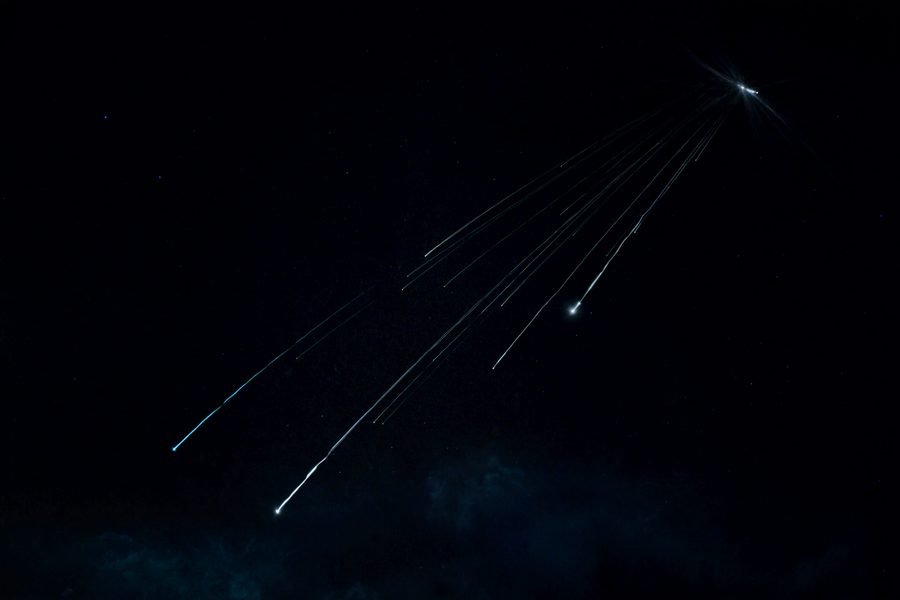
They're the Tears of Saint Lawrence: tradition says that every August the sky weeps sparks for the saint who died on 10 August in the year 258.
Partial lunar eclipse
Early hours of Friday 28 August — maximum at around 6:12 (mainland Spanish time)
The Earth passes between the Sun and the Moon, and its shadow bites 93% of the lunar disc: almost total. Visible across Spain looking west, before dawn. No glasses, no danger, just getting up a little early.
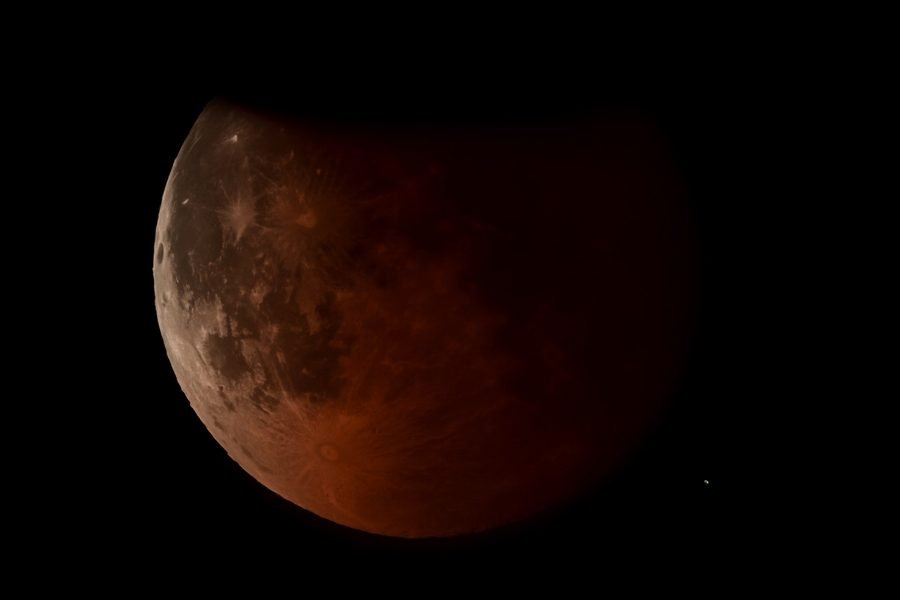
The Inca told of a jaguar biting the Moon. They made noise so that, once sated, it wouldn't come down to Earth for them.
Autumn equinox
September 22–23
Day and night last almost the same everywhere on the planet. In the ancient world it was the festival of balance and of harvest: what you sowed gets gathered in. A good day to take stock.
Saturn, on its best night
All night on 4 October
Saturn stands right opposite the Sun: it rises at dusk, sets at dawn, and is closer and brighter than at any other time of year. To the naked eye it's a yellowish star that doesn't twinkle. With steady binoculars you can already tell it isn't round.
Mercury, visible at last
Just after sunset on 12 October
Mercury hugs the Sun so closely that it's almost never visible. These days it pulls as far away as it can and shows up low, towards the west, in the half hour after sunset. Copernicus died without ever having seen it — so the legend goes.
Orionid meteor shower
Peak towards the early hours of 21 October
Fast meteors born from the dust of comet Halley — yes, that Halley. They seem to come out of Orion's belt, the hunter of the sky.
Geminid meteor shower
Peak on the night of 13-14 December
The most generous shower of the year: up to 120 meteors an hour, slow, bright and colourful. They don't come from a comet but from a mysterious asteroid called Phaethon that still has astronomers scratching their heads.
Winter solstice
December 21
The longest night of the year in the northern hemisphere. From here on, the light can only grow: that's why almost every culture lit fires on this date to celebrate the Sun being reborn.
Quadrantid meteor shower
Peak on the night of 3-4 January
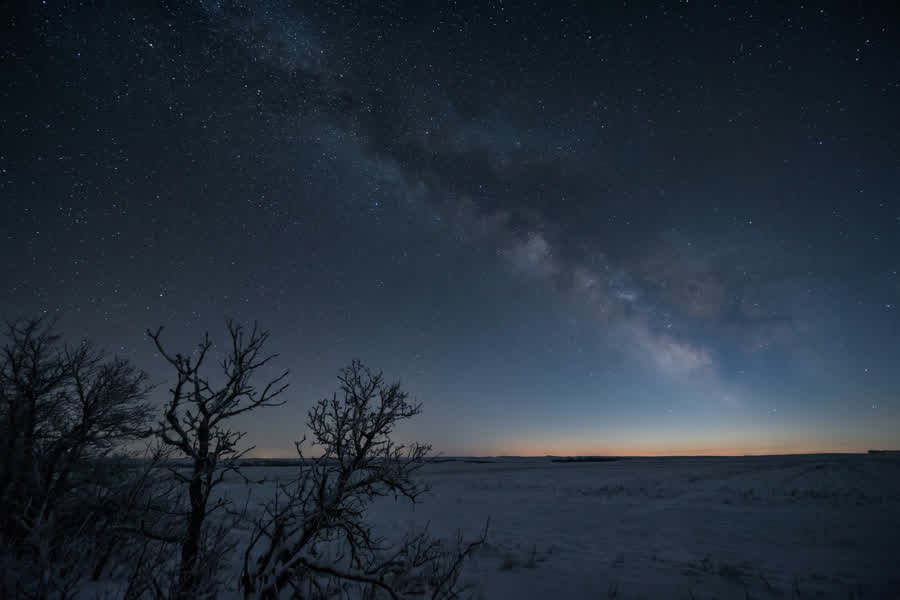
The year opens with bluish meteors born from a ghost constellation: the Mural Quadrant, officially wiped off the sky maps in 1922. The shower still carries its name.
Venus, the morning star
Before dawn on 4 January
Venus reaches its greatest distance from the Sun and dominates the eastern sky before dawn. It's the brightest object after the Moon: if you see something that looks like a plane standing still, that's it.
Jupiter, all night long
All night on 11 February
The largest planet, on its brightest night. With binoculars propped on something you can see its four biggest moons in a row — the same ones Galileo looked at, and that cost him a trial.
Mars, red and opposite
All night on 19 February
Eight days after Jupiter, it's Mars's turn. It looks clearly orange to the naked eye. This opposition is one of the distant ones: Mars appears smaller than at other times, but it stays above the horizon all night long.
Great total eclipse · southern Spain
2 August 2027, mid-morning — totality at around 10:45
The main event of the decade: the shadow will cross Cádiz, Málaga, Ceuta and Melilla. Up to 4 minutes 48 seconds of full night in broad daylight in Ceuta, nearly 3 minutes in Cádiz. Southern Spain will be the best place in Europe to live it. Start blocking out the day.
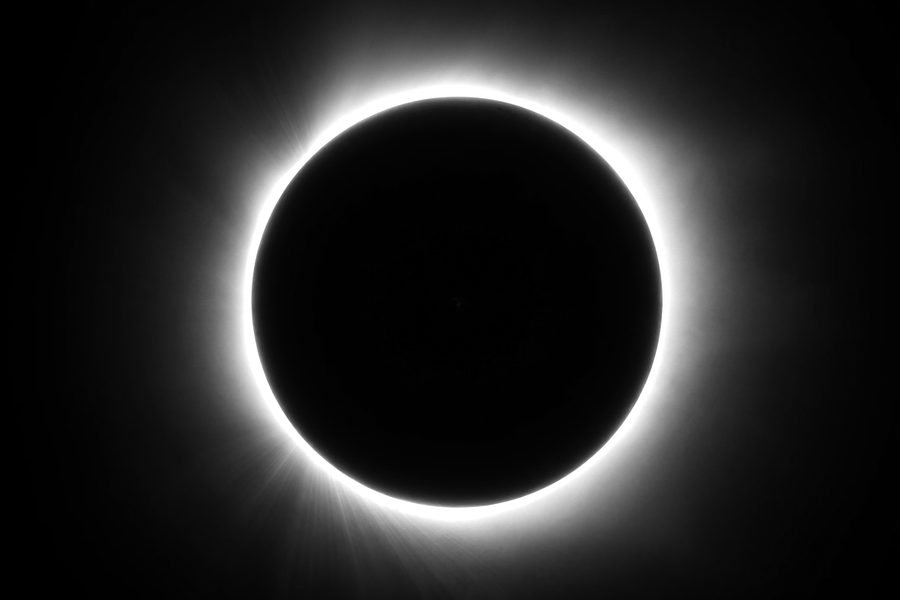
In ancient Egypt, an eclipse was Apophis, the serpent of chaos, swallowing the Sun's barque. Ra won the battle… every time.
Perseids 2027
Peak on the night of 12-13 August 2027
The Tears of Saint Lawrence are back — and this time, just ten days after the great eclipse in the south. August 2027 is going to be a month to remember.
Autumn equinox
September 23, 2027
The only day of the year, along with its March twin, when the Sun rises exactly due east and sets exactly due west from anywhere on the planet. If you have ever wanted to know where east really falls from your own window, this is the morning to look: no compass needed.
Orionid meteor shower
Peak in the small hours of October 21–22, 2027
Halley's dust again, and the fastest meteors there are: they come in at 66 km per second. The comet itself isn't back until 2061, but the trail it left behind is still floating there, and Earth crosses it every October without fail.
Geminid meteor shower
Peak on the night of December 13–14, 2027
The only major shower that doesn't ask you to stay up all night: its radiant is already high by ten in the evening. It's also young — nobody saw it before 1862 — and it gets stronger every year. Dress warmer than you think: in December, half an hour standing still outdoors gets very long.
Winter solstice
December 22, 2027, at 3:42 a.m. (mainland Spain time)
The longest night of the year. But watch out for what almost everyone takes for granted: the earliest sunset is NOT today — it was in early December — and the latest sunrise hasn't happened yet; that comes in early January. What starts stretching out today is the afternoon. Mornings will keep getting darker for another couple of weeks.
Quadrantid meteor shower
Peak on the night of January 3–4, 2028
The most temperamental shower of the year: where the Perseids hand you good nights for a week or more, this one packs almost everything into about six hours. If those small hours are cloudy where you are, there's no second chance until next year.
Annular eclipse · ring of fire over Spain
January 26, 2028, late afternoon — the partial phase begins around 17:34 in Seville and the Sun sets still eclipsed
The third in three years, and unlike the other two: this time the Moon is far out in its orbit and looks small, so it can't quite cover the Sun and leaves a ring of light burning around it. The band crosses half of Spain from southwest to northeast — nearly all of Andalusia, southern Extremadura, Castilla-La Mancha, part of Madrid, Aragon, Murcia, Valencia, part of Catalonia and the westernmost Balearics. The ring lasts 7 minutes 15 seconds in Seville, 5:24 in Granada, 3:02 in Toledo and 1:29 in Cartagena. From the rest of the country it's partial. And one difference that matters: here the eclipse glasses NEVER come off, because it never gets dark.
The Norse told of the wolf Sköll, who had chased the Sun across the sky since the world began. When he caught up, he bit — and that bite was the eclipse. The day he swallowed it whole, the end of the world would begin.
Perseids 2028
Peak on the night of August 11–12, 2028
The trick almost nobody tells you: don't look at the radiant. Meteors coming straight out of Perseus are heading towards you and look short, almost a dot; the long ones, the ones that leave a trail and make you swear out loud, appear far away from it. Lie back looking straight up and take in as much sky as you can.
Perseus, who gives his name to the constellation they seem to pour from, was born of another kind of shower: Zeus reached his mother Danaë as a shower of gold.
Orionid meteor shower
Peak in the small hours of October 21–22, 2028
In October, Orion is still a pre-dawn constellation: it doesn't rise until after midnight. So this shower asks you to get up early rather than stay up late. The reward is seeing in autumn the sky everyone associates with winter.
Orion was killed by a scorpion, the myth says. That's why they were placed on opposite sides of the sky: when Scorpius rises, Orion hides. And it's literal — you will never see the two of them at once.
Geminid meteor shower
Peak on the night of December 13–14, 2028
They're the slowest of the big showers — 35 km per second against the Perseids' 59 — and that makes them the easiest to actually see: they cross slowly, you can make out their colours, and even a phone on a tripod will catch them. If you're only going out one night a year to look up, make it this one.
Castor and Pollux were brothers, but only one of them was immortal. When Castor died, Pollux asked to share his immortality rather than be left without him. Zeus put them in the sky together, and there they still are.
Winter solstice
Morning of December 21, 2028
"Solstice" literally means "Sun standing still", and that isn't poetry: for a few days either side of today the Sun rises and sets at almost exactly the same point on the horizon, as if it braked before turning back. Mark a reference from your window — an aerial, a tree, a corner — and check it yourself a week from now.
Red Moon on New Year's Eve
December 31, 2028 — totality runs from 17:16 to 18:28, greatest around 17:52 (mainland Spain time)
The Moon rises already eclipsed: it comes up in the east a coppery red and stays that way until almost half past six. That red has an explanation, and it's a beautiful one — it's every sunrise and every sunset on Earth at once, bent by our atmosphere and projected up there. Naked eye, no filters, no danger at all: all you need is a clear eastern horizon. The next total lunar eclipse on a New Year's Eve isn't until 2066.
In Mesopotamia a lunar eclipse foretold the death of the king. Their solution was to seat a substitute on the throne while the danger lasted and hand the crown back to the real one afterwards. Things did not always go well for the substitute.
Open Tarot Dorado — free, no accountPreguntas
- Do you need a telescope?
- For none of this, no. Eclipses, meteor showers and solstices are all visible to the naked eye. For the planets a sky without streetlights nearby helps, but you'll see them anyway.
- And if the sky is cloudy?
- Then there's nothing to be done: these are events in the sky, not on a screen. That's why it's worth knowing days in advance and not the same night.
- Where do these dates come from?
- They're worked out with the same ephemerides that draw the app's sky —real positions of the Moon, the Sun and the planets— and then checked against published sources. They're not copied from any website.
- At exactly what time?
- Eclipses have a time down to the minute, and it's on each one's entry. Meteor showers don't: their peak is a whole night, and giving them an hour would be inventing a precision that doesn't exist.
Updated on 2026-09-20.