Built looking at the sky
Twenty-six sites pointing at one particular sunrise. With what's proven kept separate from what isn't — which on this subject is most of the work.
Long before there were clocks, the only way to know where in the year you stood was to watch where the Sun came up. So people built accordingly: doors, passages and windows placed so that on one particular morning —and only that one— the light would reach all the way in.
There are a thousand pages on this, and almost all of them tell the pretty part. Here each site also carries what isn't proven, which in archaeoastronomy is half the matter: with enough stones and enough directions, one of them always points at something.
Of the 26: 19 with an alignment demostrada, 6 probable y 1 discutida.
| Sitio | Where | From when | Alignment |
|---|---|---|---|
| Nabta Playa | Nubian Desert, Egypt | ≈5000 a.C. | demostrada |
| Goseck Circle | Saxony-Anhalt, Germany | ≈4900 a.C. | demostrada |
| Menga Dolmen | Antequera, Málaga | ≈3600 a.C. | demostrada |
| Mnajdra | Qrendi, Malta | ≈3600 a.C. | demostrada |
| Newgrange | Boyne Valley, Ireland | ≈3200 a.C. | demostrada |
| Maeshowe | Orkney, Scotland | ≈2800 a.C. | demostrada |
| Stonehenge | Wiltshire, England | ≈2500 a.C. | demostrada |
| Karnak | Luxor, Egypt | ≈2000 a.C. | demostrada |
| Kokino | Kumanovo, North Macedonia | ≈1800 a.C. | demostrada |
| Abu Simbel | Nubia, Egypt | ≈1250 a.C. | demostrada |
| Chankillo | Casma Valley, Peru | ≈300 a.C. | demostrada |
| El Infiernito | Villa de Leyva, Colombia | ≈ 1st century BC | demostrada |
| Teotihuacan | State of Mexico, Mexico | ≈100 d.C. | demostrada |
| Tiwanaku | La Paz, Bolivia | ≈500 d.C. | demostrada |
| Uxmal | Yucatán, Mexico | ≈900 d.C. | demostrada |
| The Sun Dagger | Chaco Canyon, New Mexico | ≈1000 d.C. | demostrada |
| Cahokia Woodhenge | Illinois, United States | ≈1100 d.C. | demostrada |
| Angkor Wat | Siem Reap, Cambodia | ≈1150 | demostrada |
| Machu Picchu | Cusco, Peru | ≈1450 | demostrada |
| Almendres Cromlech | Évora, Portugal | ≈6000 a.C. | probable |
| Rujm el-Hiri | Golan Heights | ≈3000 a.C. | probable |
| Caral | Supe Valley, Peru | ≈2600 a.C. | probable |
| Pyramids of Giza | Cairo, Egypt | ≈2560 a.C. | probable |
| Monte Albán | Oaxaca, Mexico | ≈250 a.C. | probable |
| Lost City (Teyuna) | Sierra Nevada de Santa Marta, Colombia | ≈800 d.C. | probable |
| El Castillo, Chichén Itzá | Yucatán, Mexico | ≈1000 | discutida |
One by one
Nabta Playa
Nubian Desert, Egypt · ≈5000 BC · Summer solstice
A circle of stones driven into the sand, with two pairs aligned to the summer solstice dawn. It's a thousand years older than Stonehenge and some two thousand older than the pyramids.
Goseck Circle
Saxony-Anhalt, Germany · ≈4900 BC · Winter solstice
A circular palisade enclosure with three gates. Two of them point to the sunrise and sunset of the winter solstice. It was raised around 4900 BC, when metal wasn't yet worked in Europe.
Menga Dolmen
Antequera, Málaga · ≈3600 BC · All year round
Of the thousands of dolmens in Europe, this one doesn't look at a celestial body: it looks at a mountain. Its passage points to the Peña de los Enamorados, eight kilometres away. It's the only known case, and it's two hours from Madrid.
Mnajdra
Qrendi, Malta · ≈3600 BC · Equinoxes and solstices
The most precise temple of all those surviving from that age. At the equinoxes the first ray of dawn comes in through the main door and runs along the central axis. At the solstices it lights the edges of two particular megaliths, one on each date. It's a thousand years older than Stonehenge.
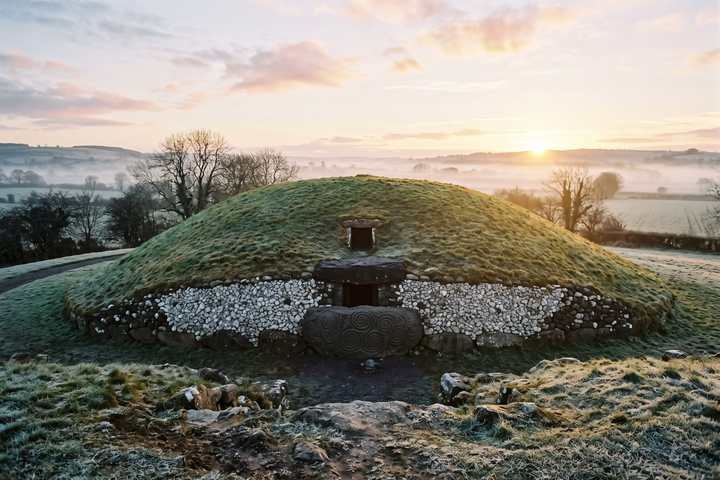
Newgrange
Boyne Valley, Ireland · ≈3200 BC · Winter solstice · 19 to 23 December
Above the entrance there's an opening made on purpose. For a few days around the solstice, and only those days, a beam of sunlight comes through it, travels nineteen metres of passage and reaches the floor of the chamber at the back. It lasts about seventeen minutes.
Maeshowe
Orkney, Scotland · ≈2800 BC · Winter solstice
A mound with an eleven-metre passage. On the afternoons near the winter solstice, the setting Sun runs its whole length and lights the back wall. A thousand years later, some Vikings got in through the roof and left runic graffiti that can still be read.
Stonehenge
Wiltshire, England · ≈2500 BC · Summer and winter solstice
From the centre of the circle, on the morning of the summer solstice the Sun rises right over the Heel Stone. The axis works both ways: looking the other way, on the afternoon of the winter solstice the Sun sets between the two largest pillars.
But: A good many archaeologists think the alignment that really mattered was the winter one, not the summer one everybody goes to.
Karnak
Luxor, Egypt · ≈2000 BC · Winter solstice
The main axis of the temple of Amun-Ra points to the spot where the Sun rises on the shortest day of the year. That morning the light runs the whole axis, court after court, and reaches the sanctuary at the back. The temple was enlarged over two thousand years and the axis was always respected.
Kokino
Kumanovo, North Macedonia · ≈1800 BC · Solstices and equinoxes
An observatory carved into the volcanic rock of a summit, with four stone seats and markers on the horizon. From them you can read the Sun's risings at solstices and equinoxes, and the Moon's at its extreme positions. NASA listed it among the most notable ancient observatories.
Abu Simbel
Nubia, Egypt · ≈1250 BC · 22 February and 22 October
Twice a year the Sun comes through the doorway, travels sixty metres of rock and reaches the back of the sanctuary, lighting three of the four seated statues. The fourth is Ptah, god of the underworld, and stays in the dark.
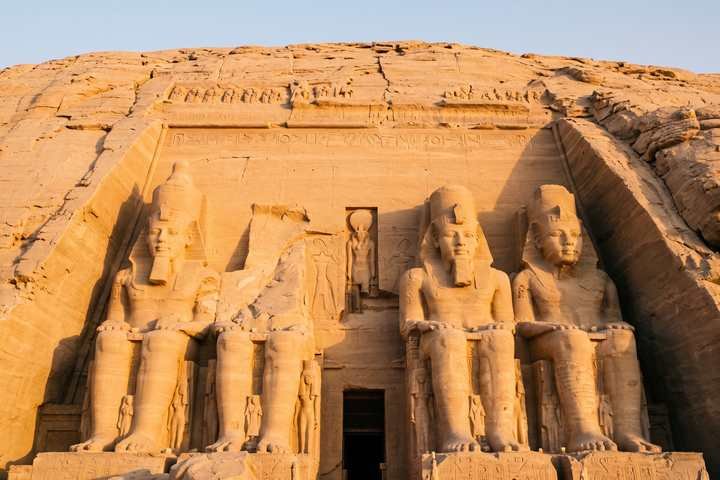
But: The temple was moved whole in 1968 to save it from the Aswan reservoir. The effect was preserved, but today it happens a day later than at its original site.
Chankillo
Casma Valley, Peru · ≈300 BC · All year round
Thirteen towers in a row along a ridge. From a marked observation point, the Sun rises every morning of the year through a different gap between them: a complete solar calendar, in stone, from which you can read the date to within a couple of days.
El Infiernito
Villa de Leyva, Colombia · ≈ 1st century BC · Solstices
Dos filas de columnas de piedra clavadas en el suelo, treinta en cada una. La sombra que proyectan al mediodía cambia de largo a lo largo del año y se iguala en las fechas señaladas: es un calendario de piedra muisca, y funciona. El nombre se lo pusieron los curas españoles del siglo XVI, que vieron las columnas fálicas y decidieron que aquello era cosa del diablo.
Teotihuacan
State of Mexico, Mexico · ≈100 AD · 11 August and 29 April
La ciudad entera está girada 15,5 grados respecto al norte, y no por capricho del terreno: esos dos días el Sol se pone exactamente alineado con el eje de la Calzada de los Muertos, visto desde la Pirámide del Sol. Entre las dos fechas hay 260 días, que es justo la cuenta del calendario ritual mesoamericano.
But: That the orientation is deliberate is accepted. Exactly which event it marked is still debated: some propose the Sun's passage through the zenith, others its setting over a point on the horizon, others the Pleiades.
Tiwanaku
La Paz, Bolivia · ≈500 AD · Equinoxes and solstices
The Kalasasaya temple has eleven pillars in its western wall. From a central point, the Sun rises by a different pillar depending on the time of year, and by the exact middle one at the equinoxes. At 3,850 metres, with the altiplano behind.
But: A good part of what you see was reconstructed in the twentieth century, and some stones didn't go back to their original places. The main alignments are documented from before that.
Uxmal
Yucatán, Mexico · ≈900 AD · Venus cycle
The Governor's Palace is turned nearly 20 degrees from the rest of the complex, and points to the spot on the horizon where Venus rises at its southernmost position — which happens every eight years. The façade carries more than three hundred carved Venus glyphs, in case there was any doubt.
The Sun Dagger
Chaco Canyon, New Mexico · ≈1000 AD · Solstices and equinoxes
High on Fajada Butte, three leaning slabs let light through in thin slits onto a spiral carved into the rock. At noon on the summer solstice, a dagger of light crosses the exact centre of the spiral. At the winter one, two daggers frame it on either side.
But: The slabs have shifted a few centimetres through soil erosion since it was documented in 1977, and the effect is no longer exactly the same. Access is closed to the public so as not to speed it up.
Cahokia Woodhenge
Illinois, United States · ≈1100 AD · Equinoxes and solstices
A circle of red cedar posts more than forty metres across. From the central post, the equinox Sun rises right behind the eastern post, and that post is also aligned with the front of the main mound, the largest pre-Hispanic earthwork in North America.
But: The posts you see today are a reconstruction over the original holes, which were indeed excavated.
Angkor Wat
Siem Reap, Cambodia · ≈1150 · Spring equinox
On the morning of the equinox, seen from the entrance causeway, the Sun rises exactly over the central tower. The whole temple faces west, the opposite of almost every other one in the area.
Machu Picchu
Cusco, Peru · ≈1450 · June solstice
In the Torreón there's a trapezoidal window. On the morning of the June solstice the Sun comes through it and falls on a carved rock in the centre of the room. At the Intihuatana, higher up, the pillar's shadow almost disappears at noon on the equinoxes.
Almendres Cromlech
Évora, Portugal · ≈6000 BC · Equinoxes
Almost a hundred menhirs in two circles, raised around 6000 BC — two thousand years before Stonehenge and a thousand before the temples of Malta. It's the oldest megalithic complex in Europe still standing, and several of its menhirs align with the Sun's rising at the equinoxes.
But: The site was rearranged over millennia and not all the stones are in their original position, so the alignments are read with caution.
Rujm el-Hiri
Golan Heights · ≈3000 BC · Summer solstice
Five concentric circles of basalt stone, forty thousand tonnes, with a mound at the centre. Two openings in the outer wall point to the summer solstice sunrise and to the equinox dawn. It's called “the wheel of the spirits”.
But: A 2024 study recalculated the ground's rotation from tectonic drift since it was built and concludes that the alignments may not have been the ones seen today. The debate is open.
Caral
Supe Valley, Peru · ≈2600 BC · Solstices
The oldest city in the Americas: 5,000 years, contemporary with the pyramids of Egypt and the first Stonehenge. Six pyramids and two sunken circular plazas, without a single weapon or wall in the whole excavation. Several structures align with the Sun's risings and settings at the solstices.
Pyramids of Giza
Cairo, Egypt · ≈2560 BC · All year round
Las caras de la Gran Pirámide están orientadas a los cuatro puntos cardinales con un error de unos tres minutos de arco: la veinteava parte de un grado. Eso está medido y nadie lo discute. Cómo lo consiguieron sin brújula sigue siendo materia de debate; la explicación con más apoyo usa dos estrellas circumpolares.
But: Lo que sí se discute —y mucho— es la otra idea: que las tres pirámides reproduzcan el cinturón de Orión. La propuso Robert Bauval en 1989 y es la que ha corrido por todas partes, pero la egiptología mayoritaria la rechaza: las proporciones no encajan bien y el emplazamiento se explica por el terreno y por la roca disponible.
Monte Albán
Oaxaca, Mexico · ≈250 BC · Rising of Capella
The whole complex follows one orientation except Building J, which is turned and shaped like an arrowhead. It points to the spot on the horizon where Capella —one of the brightest stars— used to rise just before dawn on the day the Sun passes through the zenith above the city.
But: The reading is Anthony Aveni's and is fairly well accepted, but not unanimous: some argue the building was oriented to a point on the ground and not to a star.
Lost City (Teyuna)
Sierra Nevada de Santa Marta, Colombia · ≈800 AD · Solstices
Two hundred stone terraces stepped into deep jungle, at 1,200 metres. It was built some 650 years before Machu Picchu and wasn't rediscovered until 1972. The Kogi, descendants of those who raised it, still live in the sierra and consider it the heart of the world.
But: The astronomical orientations of the terraces have been little studied. What is documented is that the Kogi organise their calendar by the Sun and the Pleiades.
El Castillo, Chichén Itzá
Yucatán, Mexico · ≈1000 · Near the equinoxes
On late afternoons in March and September, the pyramid's stepped edge casts a zigzag shadow onto the northern balustrade that ends in a carved serpent's head. The body seems to come down the staircase.
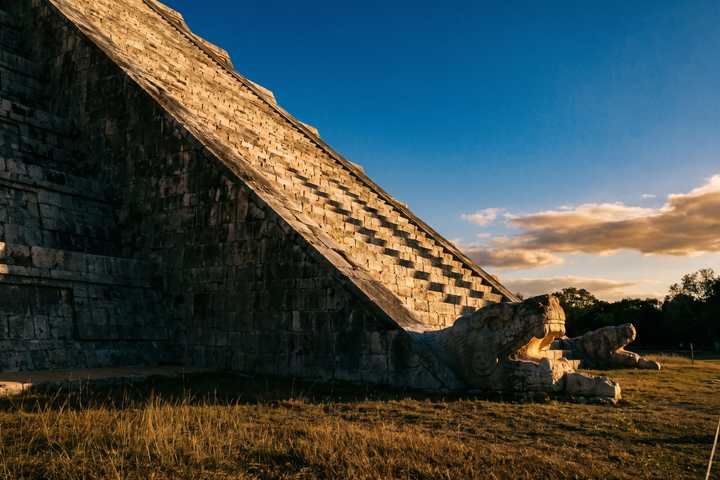
But: The effect is real and can be photographed, but it doesn't happen only on the equinox: it's visible for several weeks. Whether the Maya sought it deliberately isn't proven — no ancient source mentions it, and the first descriptions are from the twentieth century.
Open Tarot Dorado — free, no accountPreguntas
- What is archaeoastronomy?
- The study of how ancient cultures observed the sky and built accordingly. It isn't an esoteric discipline: it's done by measuring real orientations and checking them against where the Sun and the stars were at the time, which isn't where they are today.
- Why are some alignments “disputed”?
- Because with enough stones and enough directions, one of them always points at something. An alignment convinces when it's precise, when it repeats across several buildings on the same site, and when there's some sign that those people cared about that date.
- Can you visit them?
- Almost all of them, yes. But on the exact day of the solstice or equinox there's usually a queue and a crowd: at several of them the effect looks the same for days or weeks around the date.
- Does the Sun rise today where it rose back then?
- In almost the same place at the solstices. What has changed a lot is where the stars rise: Earth's axis wobbles, and over five thousand years that moves a star several degrees. That's why stellar alignments are checked against the position of their own time, not today's.
Updated on 2026-09-20.