Lunar calendar 2026 and 2027
The year's new and full moons, calculated. And along the way, the answer to the question everyone gets wrong: the Moon's month does not last 28 days.
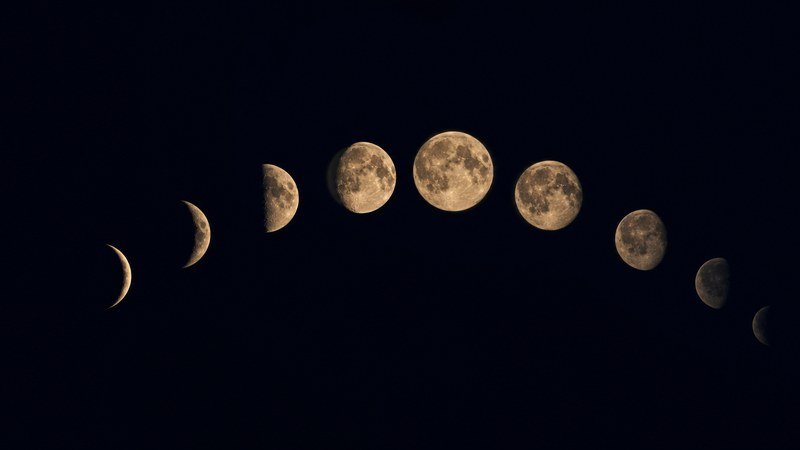
The moons of 2026
| Fase | Fecha | Hora |
|---|---|---|
| New moon | 18 January | 19:53 UTC |
| Full moon | 1 February | 22:10 UTC |
| New moon | 17 February | 12:03 UTC |
| Full moon | 3 March | 11:40 UTC |
| New moon | 19 March | 01:25 UTC |
| Full moon | 2 April | 02:15 UTC |
| New moon | 17 April | 11:53 UTC |
| Full moon | 1 May | 17:25 UTC |
| New moon | 16 May | 20:03 UTC |
| Full moon | 31 May | 08:47 UTC |
| New moon | 15 June | 02:56 UTC |
| Full moon | 29 June | 23:58 UTC |
| New moon | 14 July | 09:45 UTC |
| Full moon | 29 July | 14:36 UTC |
| New moon | 12 August | 17:37 UTC |
| Full moon | 28 August | 04:18 UTC |
| New moon | 11 September | 03:26 UTC |
| Full moon | 26 September | 16:48 UTC |
| New moon | 10 October | 15:50 UTC |
| Full moon | 26 October | 04:12 UTC |
| New moon | 9 November | 07:02 UTC |
| Full moon | 24 November | 14:56 UTC |
| New moon | 9 December | 00:53 UTC |
| Full moon | 24 December | 01:30 UTC |
The moons of 2027
| Fase | Fecha | Hora |
|---|---|---|
| New moon | 7 January | 20:25 UTC |
| Full moon | 22 January | 12:17 UTC |
| New moon | 6 February | 15:57 UTC |
| Full moon | 20 February | 23:23 UTC |
| New moon | 8 March | 09:31 UTC |
| Full moon | 22 March | 10:45 UTC |
| New moon | 6 April | 23:53 UTC |
| Full moon | 20 April | 22:30 UTC |
| New moon | 6 May | 11:01 UTC |
| Full moon | 20 May | 11:01 UTC |
| New moon | 4 June | 19:42 UTC |
| Full moon | 19 June | 00:45 UTC |
| New moon | 4 July | 03:03 UTC |
| Full moon | 18 July | 15:46 UTC |
| New moon | 2 August | 10:06 UTC |
| Full moon | 17 August | 07:30 UTC |
| New moon | 31 August | 17:42 UTC |
| Full moon | 15 September | 23:04 UTC |
| New moon | 30 September | 02:36 UTC |
| Full moon | 15 October | 13:47 UTC |
| New moon | 29 October | 13:37 UTC |
| Full moon | 14 November | 03:27 UTC |
| New moon | 28 November | 03:25 UTC |
| Full moon | 13 December | 16:11 UTC |
| New moon | 27 December | 20:13 UTC |
| Full moon | 12 January | 04:04 UTC |
Times are in UTC. In mainland Spain you have to add one hour in winter and two in summer. The app handles this on its own and gives it to you in your own time, wherever you're looking from.
The lunar month does not last 28 days
It's the most repeated mistake, and it comes from mixing up two things that do exist but aren't the same:
29 days, 12 hours and 44 minutes — or 29.53 days — is how long the Moon takes to return to the same phase. From new moon to new moon. That's the month you can see, the one lunar calendars run on, and the one that makes Ramadan shift every year.
27.32 days is how long it takes to go all the way round with respect to the stars. It's shorter because, while the Moon completes its orbit, the Earth has moved along its own around the Sun, and it takes a couple more days for the light to fall the same way again.
That's where the 28 comes from: from the calendar of the 28 mansions of the Moon, which spreads those 27.32 days over twenty-eight nights, one for each group of stars it rises beside.
Why some years have thirteen moons
Twelve lunar months add up to 354 days. The solar year has 365. Eleven days are left over each year, so every two or three years an extra full moon falls: those are the thirteen-moon years, and that's why lunisolar calendars —the Hebrew one, the Chinese one— slot in a whole extra month now and then to keep from drifting.
The Islamic calendar doesn't do that: which is why its months travel through all the seasons in 33 years.
Open Tarot Dorado — free, no accountPreguntas
- When is the next full moon?
- Those for 2026 and 2027 are in the tables above with their exact time. The app also tells you how high it will be above your horizon that night and from which window you'll see it.
- Exactly how long is a lunar month?
- 29 days, 12 hours, 44 minutes and 3 seconds on average — 29.53 days. I say “on average” because the Moon's orbit is oval and some months run up to seven hours longer than others.
- Why do people say the lunar cycle is 28 days?
- Out of confusion with the sidereal month (27.32 days) and with the calendar of the 28 lunar mansions. The month of the phases, the one you see, is 29.5.
- Does the full moon affect sleep or mood?
- Some studies find small differences in how long people sleep and many others find nothing at all. The honest answer is that it isn't clear. What is measurable is the light: a full moon is bright enough to read a headline outdoors.
Updated on 2026-09-20.