The lines of the hand
What each line is, how to find it on your own palm, and what has been said about them for centuries — told without promising you anything.
First things first, the important bit: the life line does not say how long you'll live. It never has, not even in the tradition it comes from. It's the longest and the deepest, and that's how it got the name — but there's no study linking its length to anything.
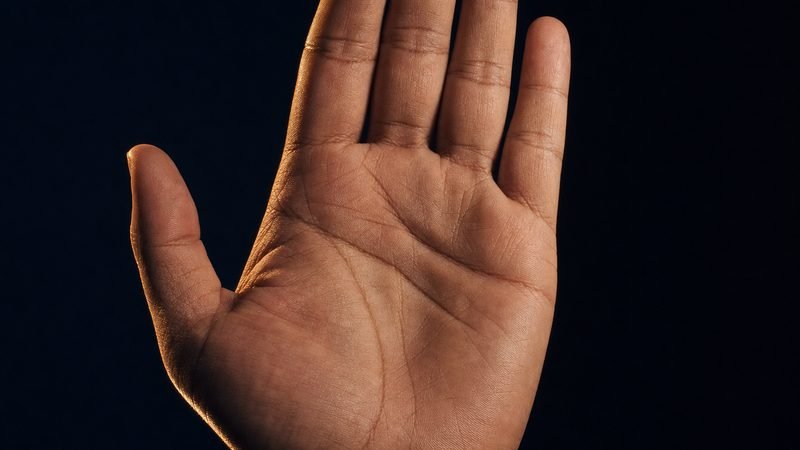
The heart line
The topmost one. It starts below the little finger and crosses the palm towards the index. It's the first you see when you open your hand.
Tradition ties it to how you relate to others: if it starts high and straight, to someone who keeps their distance; if it dips and curves towards the index finger, to someone who throws themselves in. The little branches going up are read as openings, the ones going down as fallings-out.
The head line
The middle one, between the heart and the life line. It usually starts by the thumb and crosses towards the edge of the hand.
It's read as the way you think. Short and straight: practical, to the point. Long and sloping: imaginative, turns things over. If it starts joined to the life line they say there's caution; if it starts apart, early independence.
The life line
The one curving round the base of the thumb in an arc. It's the deepest of the three and the easiest to find.
Tradition reads it as vitality and as the big changes — not as length of life. A wide arc is linked to energy; one hugging the thumb, to a more sheltered life. The lines crossing it are read as the moments when everything moved.
The four types of hand
Before the lines, tradition looks at the shape. Two measurements are crossed: whether the palm is more square or more elongated, and whether the fingers are long or short in relation to it.
| Tipo | Palma | Dedos |
|---|---|---|
| Tierra | Cuadrada | Cortos |
| Aire | Cuadrada | Largos |
| Fuego | Alargada | Cortos |
| Agua | Alargada | Largos |
This part can be measured, and that's what the app does: it measures your palm and fingers with the camera and tells you your proportions. The reading that comes after is tradition; the measurement is a measurement.
Which hand to look at
The classic answer: the hand you don't write with tells what you were given, and the one you write with what you've done with it. If they're very different, tradition reads that as having moved a long way from where you were headed.
The app reads your hand with the camera and draws your lines on top of your palm. The photo doesn't leave your phone: it's analysed on the device itself and deleted when you leave. No upload, no server, no account.
Preguntas
- Does the life line say how long I'll live?
- No. Neither the tradition it comes from says so, nor is there any study backing it. It's the deepest line on the palm and that's why it got the name.
- Which hand should you look at?
- According to tradition, the hand you don't write with shows what you were given and the one you write with what you've done. The app reads both and tells you how they differ.
- What if I don't have one of the three lines?
- It happens, and it doesn't mean anything bad. The head line and the heart line appear joined into one in about 3 % of people. It's a common anatomical variant.
- Can you read a palm with a phone?
- The app measures the palm and fingers and finds the main lines in the photo itself, inside the phone. And it says no when the measurements don't add up, instead of making up a result.
- Is this reliable?
- The measurement of the hand, yes: that's geometry. The reading is tradition, and like any tradition it's worth what it's worth to whoever hears it. It predicts nothing.
Updated on 2026-09-20.